work and violence
I just finished James Lee Burke's To the Bright and Shining Sun, set in 1960's Appalachia, which feels antiquated compared with my own vision of that time. I don't have that much to say about it. It's about a coal miner who struggles with the company and the union's betrayal, as well as the physical toll of mining life. It has many of the standard tropes of working-class lit, rusting Fords, violence, hunger, anger, etc.
Hapke in her epic Labor's Text briefly mentions the book and the protagonist Perry James's "sporting a tattoo with a UMW logo and a Confederate flag" (305). Is that necessarily ironic? Was the UMW really egalitarian about race? I doubt it, but I can't say for sure.
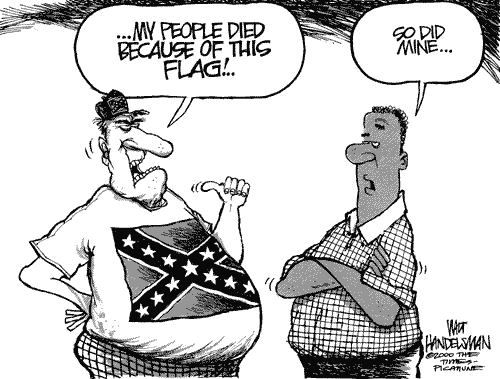
Perry explains to a fellow Job Corps member, who is African American and calls the tattoo a "bad news flag" that it doesn't mean that for him.
I wonder about that. Can the confederate flag ever mean Southern pride or will it always be tinged with racism?
Again, there is another typical tension--welfare. Perry, the man of the house after his father's death, resists welfare. When he does eventually apply for it, it is predictably a bureaucratic nightmare. He struggles to be literate and feels his life is controlled by white shirts who never get dirty and rule his life through paper:
[H]e knew that regardless of what he did in reprisal against Bud Winston, Mr. Call, or Mrs. Lester, they still had their world of paper, legal signatures, and authority on their side, and they could affect his family's life in any way they wished whenever they desired. In his exhaustion, he saw them holding the same power as the mining association, which, on a whim, could suddenly evict his family from the cabin, shut off their supply of food at the store, fire him from his job, blacklist him at every mine on the plateau, kill his father, and finally take his brothers and two sisters from home" (189).
In the end he hops a train to Cincinnati, having just rejected the opportunity to take revenge on his father's murderers. I suspect we are supposed to love perry at this moment when he rides of into his fantasy future of drinking beer and betting on horses. However it's worth noting that he doesn't include his family in his fantasizing. There is no mention of sending money home, or even of returning to Jobs Corps. Perry seems to be saying, "F-- it all." He's throwing off the union, the family, the Job Corps, striking out alone, as every great American hero must, or arguably every great hero-adventurer. But while many adventurers return we get the sense that it's better for Perry to just stay away from a land so devastated physically, emotionally, and financially by mining.
Labels: books
posted by tj @ Friday, September 10, 2010
0 Comments


0 Comments:
Post a Comment
Subscribe to Post Comments [Atom]
<< Home